Flip 7 review: a small card game with big risks
Flip 7 is my pick for quick rounds and big reactions. Buy it if your group enjoys risk. Skip it if you want careful strategy to beat luck.
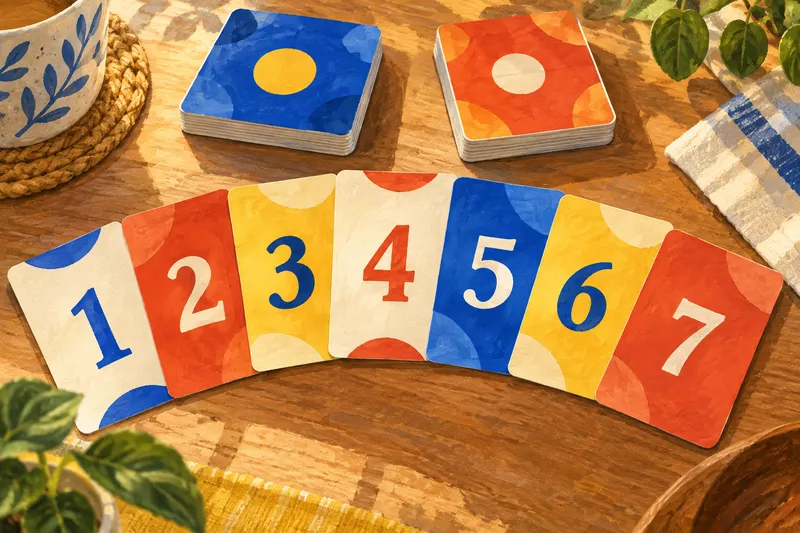
One more card looks harmless until it costs the whole round. That is the heart of Flip 7. You build a row of numbers, decide whether to keep going, and hope the next card is new.
My verdict: the Flip 7 card game earns a place at casual game nights. It is quick to teach and gives a group a shared moment on almost every draw. It is a poor fit for players who want skill to settle most results.
I would buy it as a light start or finish to an evening. I would not ask it to fill the same role as a long strategy board game. Its charm comes from small choices with sudden swings.
Flip 7 at a glance
| Detail | What to expect |
|---|---|
| Current box | Flip 7, 2nd Edition, from The Op Games |
| Players and ages | 3 or more players, ages 8+ |
| Time | About 20 minutes |
| Contents | 94 cards and rules |
| Core choice | Take a card or stop and bank your score |
| Best fit | A group that enjoys luck, risk, and quick rounds |
How do you play the Flip 7 card game?
The basic loop is easy. On your turn, take a card or stay. Each different number in front of you adds to your score. Draw a number you already have and you bust, losing that round's points unless a Second Chance card saves you.
Reach seven different number cards and you end the round with 15 bonus points. Otherwise, the round ends when no one is still taking cards. Add the scores and start again. The race is to reach at least 200 points, with the highest score winning.
The official how-to-play guide is a useful first stop. Teach the hit-or-stay choice before you explain every special card. A sample round makes the idea clear far faster than a speech.
The risk is uneven. High numbers have more copies in the deck than low ones. A high card adds more points, but it also gives you a number that is more likely to appear again. That tradeoff keeps the next draw interesting.
A simple round example
Say you have a 4, a 7, and a 10. Those number cards are worth 21 points. You can stop and keep them. If you take another card and get a new number, the score grows. If it is another 7, you normally lose the round's score.
You do not lose points from earlier rounds. That is worth saying aloud when you teach kids. A bust hurts this turn at the table, not the whole score sheet.
I like this clear boundary. It lets players take a chance without wiping out the whole game. It also gives someone who busts a reason to come back ready for the next round.
Number cards, modifier cards, and special cards
Flip 7 adds a few twists to a plain push-your-luck game. Number cards build the base score. Modifier cards raise it. Action cards can stop a player, force more draws, or protect a row.
| Card | Effect to remember |
|---|---|
| Score modifier | Adds points or doubles the number-card total |
| Freeze | Stops a player who is still active |
| Flip Three | Makes an active player take three cards |
| Second Chance | Protects against a duplicate number once |
These cards can change the mood fast. A player who planned to stay may have to face more risk. A safe-looking row may freeze before it gets large. That makes Flip 7 a social game as well as a string of private choices.
For rule disputes, use The Op's Flip 7 FAQ. It clears up who chooses an action target and how the last active player handles Freeze or Flip Three. Settling those points once helps later game nights run well.
Get the scoring order right
First add the values on your number cards. Apply a multiplier to that amount. Then add the extra points from other modifiers. If you reached seven unique numbers, add the 15-point bonus last.
For example, a number-card total of 20 with a ×2 card and a +6 card scores 46. You double 20 to make 40, then add six. You do not double the +6 as well.
This is the part I would put on a small note beside the score sheet. The core game is easy to learn, but a scoring mistake can linger for several rounds if nobody spots it.
Why Flip 7 works for casual game nights
The next card matters to the whole table
Players can see the row you have built. They know when you are close to a big score. That makes it easy to follow a friend's turn and cheer for a risky choice.
Some card games hide most of the action in a hand. Flip 7 puts the risk out where everyone can see it. I favor that for a mixed group that wants to chat while it plays.
It does not ask for a long rules lesson
Hit or stay is a clear choice. A new player can understand it with three cards on the table. The special cards add rules, but they do not change the main goal.
That makes Flip 7 useful when friends arrive at different times or when a family wants a short game before a bigger one. Start a new full game for late arrivals so everyone has a fair score.
A comeback stays possible
One strong round can close a gap. I like that for a light party game: a poor start need not decide the night. It gives the player at the back a reason to keep watching.
The same swing can annoy someone who has banked careful scores all game. Both reactions make sense. The question is whether your group finds that change fun.
Where Flip 7 falls short
Luck can beat a sensible choice. You can judge the risk and still draw the one number that ruins your round. There is strategy in when to stop, but there is no sure path to a good result.
Early busts leave players waiting. Rounds move on, yet a player who goes out on the first few cards may have little to do. Keep the dealer's pace steady. Long debates over every hit make that wait worse.
Action cards can feel personal. When you can aim a card at someone, a light game may gain an edge. I would set a friendly tone before kids start using each card to settle old scores.
It has a narrow job. This is a small game of risk and reaction. It does not build a rich world or a long plan. That is fine for 20 minutes. It may feel thin if it is the only game for a whole evening.
Those limits also appear in players' views on whether Flip 7 is worth it. Some praise the simple rules and lively group play. Others want more control or depth. I read that split as a good reason to match the game to the crowd, not buy from the loudest claim on the box.
Is there useful strategy in Flip 7?
Yes, but keep your hopes in scale. A few good habits can shape a choice. They cannot make the deck give you what you want.
Look at the numbers you already have
A row with common high numbers carries a different risk from one with rare low numbers. Do not count only how many cards are in front of you. Look at which numbers they show.
Card counting can help you notice what has left the deck. I would not turn casual game nights into a long math exercise, though. The gain must be worth the delay for everyone else.
Look at the score, not just the dream
If a modest bank puts you ahead, that may be enough. If the game is about to end and you trail by a lot, you may need a bigger swing. There is no fixed rule that you should always stop at a certain number of cards.
Chasing seven different numbers is tempting because the bonus is clear. It is still a gamble with the round's points. Do not treat a row of six as a promise that the seventh is due.
Use protection for what it actually does
A Second Chance card changes the risk of a duplicate number. It is not a shield from every action. Knowing that limit keeps a bold choice from resting on the wrong rule.
My advice is to learn the few card effects well, then play at a good pace. The game is more fun when everyone knows the stakes than when one person knows obscure details and the rest guess.
Is Flip 7 good for kids and families?
The Op lists Flip 7 for ages eight and up. The small set of core rules helps, but kids still need to add scores and cope with a bust. An adult can handle the math while each child makes the hit-or-stay choice.
I would avoid pushing a child to take a card just because the rest of the table wants a dramatic moment. Let them bank a small score. Choosing when to stop is part of their turn.
It also helps to separate a bad result from a bad choice. A good risk can fail. A poor risk can pay off. That is the nature of luck, and it is why this family game should stay light.
For a longer evening with more planning, my best family board games guide has choices by group size and mood. Flip 7 works best as one useful part of a small collection.
Flip 7 questions before you buy
Can two people play?
The current official box lists three or more players. I would buy for that range. If you mostly play as a pair, choose a game sold for two rather than rely on a house rule.
Do you need a board or an app?
No. You need the cards, room for each player's row, and a way to note scores. Paper and a pen work. A board game table is not required, but leave enough clear space to see each row.
What if players tie at 200 or more?
The publisher's FAQ says all players keep playing rounds until there is a single winner. Do not break a tie by giving the win to the person who happened to take a turn first.
Which edition should I look for?
The current official Flip 7 listing is the second edition with 94 cards. Check the edition on the seller's page and use the rules that come with that box. A similar title or older photo is not enough to confirm the contents.
What if our group dislikes luck?
Skip this one. A clever stopping rule cannot remove the draw. If your friends want shared laughs with no need for a serious score, my Telestrations review offers another kind of party game. It needs at least four players and a willingness to draw.
My final take on Flip 7
I recommend Flip 7 for a family or group of friends who enjoy quick rounds and a loud reaction to one card. It is small, easy to teach, and clear about what happens on a turn.
Buy it for that job. If you want a game where a careful plan usually wins, spend your money elsewhere. If you want to watch someone bank 12 points while a friend risks 40, this deck has a good reason to come out.