Telestrations review: when bad drawings win
Telestrations is a great pick for four to eight people who want shared laughs. Drawing skill is optional. A willing group is essential.
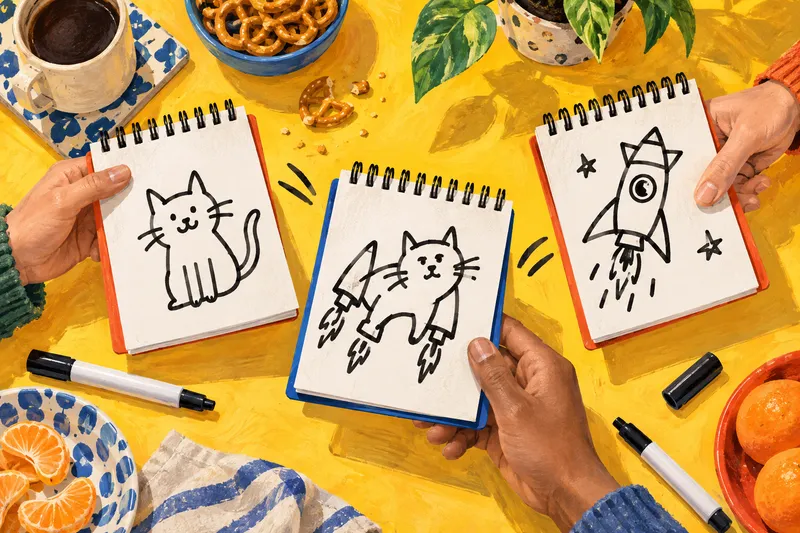
A drawing can go wrong in a way that makes the whole night better. That is the appeal of Telestrations. One person draws a word. The next writes a guess. Soon a harmless prompt has taken a very odd trip.
I would choose this party game for a group that wants to laugh together. I would pass if the main aim is to prove who is best. Telestrations has scoring rules, but the reveal is the part worth gathering for.
Telestrations at a glance
| Detail | What to know |
|---|---|
| Version | Telestrations 8 Player, 2nd Edition |
| Group | 4-8 players, ages 10+ |
| Time | About 30 minutes |
| In the box | 130 prompt cards, eight sketchbooks, eight dry-erase markers, and rules |
| My verdict | Great for a willing crowd; a poor fit for two or three people |
How the Telestrations party game works
Think of the old telephone game with drawings in place of whispers. In Telestrations, players draw at once, then pass their books. You only respond to the last page you see. You cannot trace the whole story back to its start.
The current Telestrations rules explain the setup for odd and even groups. That small step helps each book end with a guess. Keep it close for the first round.
- Each player takes a book, a marker, and a prompt card.
- Use the setup for your group, then draw or guess on the next page.
- Hide your work and pass left when everyone is ready.
- Keep going until your own book comes back.
- Take turns showing the whole chain to the group.
The last step deserves room. If everyone flips through their own book at once, you miss half the jokes. Let one player share, then move on. Telestrations gives each book its own reveal.
A Telestrations round in one silly example
Imagine the original word is "lighthouse." One player draws a tall shape and a beam. The next player writes "a giant flashlight." A third tries to draw that guess. The last player sees a torch with legs. A few passes can take the word a long way from home.
Each new page follows what came just before it. Players are not trying to recover secret words they have never seen. They draw what is in front of them, or write what they think a sketch means. That is where Telestrations finds its unpredictable outcomes.
Why bad drawings can make a good game night
Telestrations does not need a room full of artists. An unclear sketch gives the next player a choice. They may see a fish where you meant a shoe. The next sketch then follows the fish. No one has to plan a joke for that to be funny.
I like this kind of party game because the group makes the result. The same prompt can take a new path with different players. You can know the word and still have no clue what it will look like six pages later.
Players in this discussion of Telestrations for adults describe having fun with the regular family version. The appeal does not depend on rude prompts. It depends on how your friends read one another's sketches.
That is also why I would keep the mood kind. Laugh at the wild change in the book. Do not turn a player's drawing into a running insult. A party game works better when everyone feels free to try.
Who should buy Telestrations?
A group that likes a shared joke
Telestrations is a strong choice for friends, family visits, and game night with a mixed crowd. Players do not need a long history with board games. The draw-and-guess loop is easy to show.
It is especially useful when one person tends to win every strategy game. Here, a neat drawing is not the whole point. A rough sketch can give the group just as much to enjoy.
A family with confident readers
The publisher lists ages ten and up. Younger kids may need help with words, and that help can reveal a secret prompt. I would check reading comfort before using the age alone as a guide.
Players must also feel okay with drawing in front of others. Some love it. Some do not. Give a hesitant guest an easy first prompt and room to watch a reveal before they join.
Six to eight players with room to spread out
The box supports four to eight players. I favor a fuller group because a longer chain gives a word more chances to change. That is an editorial preference, not a rule that four cannot be fun.
Each player needs space for a book and an elbow. A crowded coffee table may be less useful than it looks. Set drinks aside so a spill does not become the night's main event.
Where Telestrations falls short
It does not suit a small household on its own. Two or three players fall below this edition's range. Do not buy the eight-player box on the hope that it will become a two-player game.
It can get loud. That is good at a party and less good beside someone who needs quiet. A slow reveal can also drag if one person explains every line of a sketch.
The tools need care. Wipe the pages clean before packing up and cap the markers. The books are reusable, but dry ink and lost pens add needless fuss.
The score is a side dish. If your group needs a tight contest, I would choose a different game. My family board game guide has choices built around planning and points.
Should you keep score?
I would skip points for a first game. Let players learn the rhythm and enjoy each book's strange path. No score sheet is needed to tell you that a reveal landed well.
If you do want a winner, the rules give two choices. Friendly scoring awards points for favorite sketches and guesses, plus a successful final match. Competitive scoring rewards links in the chain that keep a guess on track. Play three rounds and add the totals.
Agree on the mode before you start. Switching from free laughs to strict points halfway through can feel unfair. Players may have made very different choices if they knew what counted.
Keep the game fresh without adding work
Change seats so books pass through a new chain of minds. Try an unused card side. Let a new player lead the reveal. Those small changes can do more for Telestrations than a long list of house rules.
For a short break between rounds, a card game gives hands a rest. My Flip 7 review covers a quick choice for that spot. It trades drawing for luck, so check whether your group enjoys that kind of risk.
Telestrations questions before you buy
Does Telestrations need good drawings?
No. Draw a clear idea if you can, but do not hold the game up to fix every line. Other players need something to guess, not a work of art. I would rather see a quick, brave sketch than watch a nervous player erase the same page for five minutes.
Can Telestrations work with six players?
Yes. Six fits the four-to-eight-player range of this Telestrations box. You can play with six family members without changing to another version. With eight players, the book passes through more hands before the reveal.
Is it a board game or a drawing activity?
Telestrations fits both sorts of game night. It has cards, components, and rules like a board game. Yet I favor it as a shared activity. Friends laughing at the same odd guess matter more to me here than who has the most points.
My Telestrations verdict
I recommend Telestrations 8 Player for a crowd that wants a shared laugh more than a hard-earned win. The best reason to buy is the loop itself: draw, guess, pass, and then see where it all went wrong.
Buy it for the people who will be there. A willing group of six beats a shelf full of party games waiting for guests.